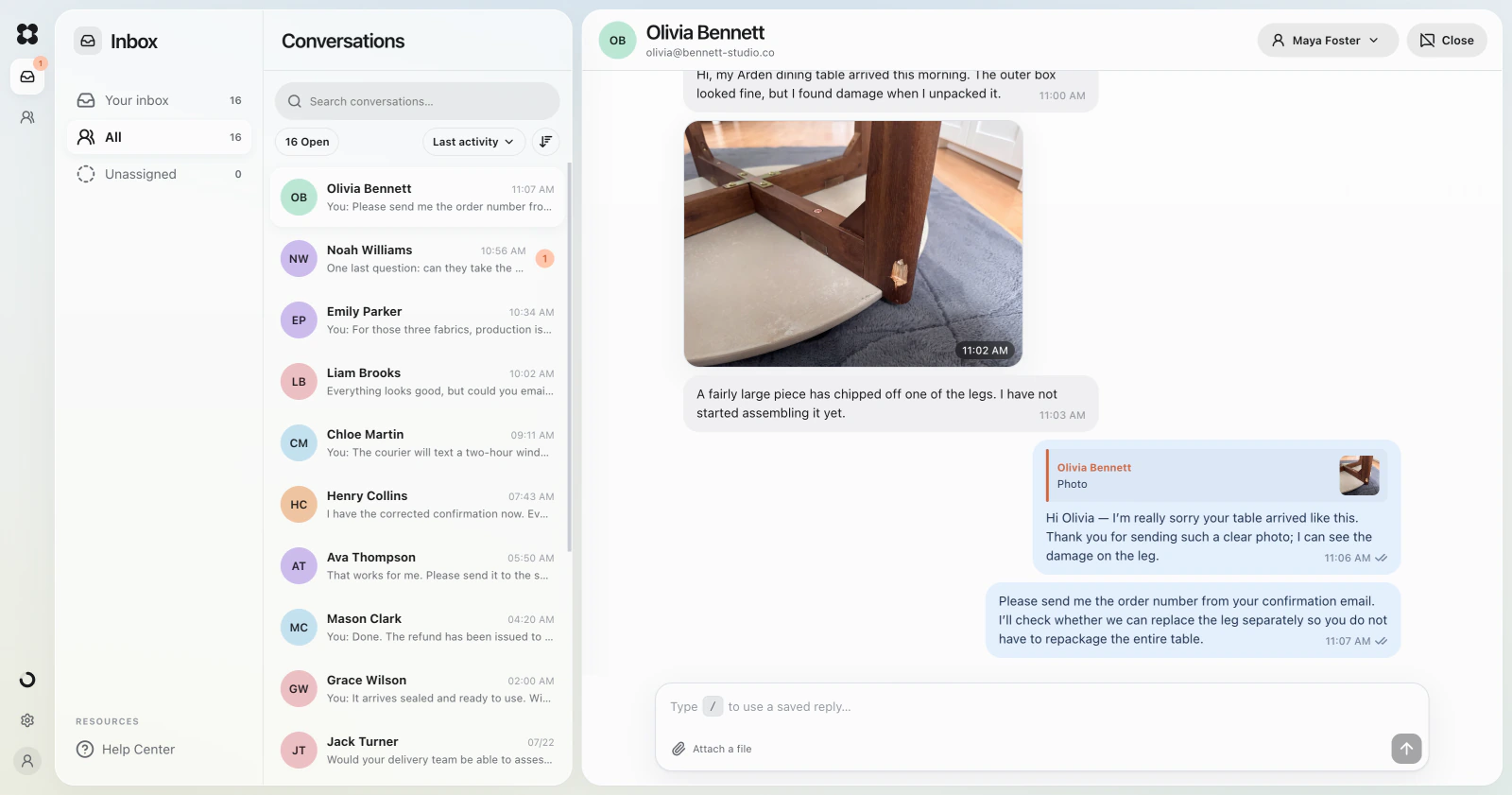
An AI front office for busy trade businesses. It replies while the customer is still choosing, gathers the details your field team needs and offers only appointment times you can keep.
Customer records, service rules, job history and delivery updates often live across a notebook, a spreadsheet and somebody's memory. Lavenity keeps them with the enquiry, ready for the next person and the next visit.
A returning customer does not type their address again, and the technician can see which unit or appliance is there and what happened last time before leaving the workshop. That saves a phone call and a search through old messages.
Every change is logged: what ran, on what, whether Ven or a person did it, and how it ended — including the ones policy refused. It is the record you want when a customer asks why they were told that.
Request created09:38
Ven
Details captured09:41
Ven
Booking blocked09:41
Ven · service not allowed
You always know whether it reached the customer
Confirmations, quotes and job updates all carry a visible delivery status. If sending fails, Lavenity retries and shows you what happened, so you can fix it before it becomes a missed visit.
Four steps from a new enquiry to a technician at the door
Your office already handles all four. Lavenity takes on the typing, checking and chasing, while stopping short of any promise or decision that should still be yours.
This is not a chatbot bolted onto a calendar. Ven proposes a structured next step; Lavenity checks the current job, your permissions and your rules before it acts. That is why confirming twice still produces one booking, not a second van.
You decide how much the AI may do, and what is still on the way
Every workspace starts in Observe, where Ven writes down what it would have done and changes nothing. You climb from there, one mode and one service at a time. The last three cards are on the roadmap and say so.
Working hours in your time zone, the suburbs and postcodes you cover, and what happens to an emergency at 23:40. Lavenity checks all three before a time is ever offered.
Front office policyv7
Working hoursMon–Fri 07:00–17:00 · Australia/Sydney
Service zonesPostcodes 2000–2234
EmergencyOut of hours → straight to a human
Bookable services2 of 9 allowed
Coming soon
Your technicians' own calendars
Two-way sync with Google and Microsoft will let outside commitments block a time and put each confirmed visit into the calendar your technicians already check. Lavenity's own week view is live today; those connectors are next.
Booked visitsExternal busy
Mon
Tue
Wed
Thu
Fri
Coming soon
A price is a commitment
Ven drafts the quote from the service template and what it learned; a named person approves it before it goes anywhere. Nothing financially binding is ever sent autonomously.
Quote draft by Ven
Split-system service, 90 minA$180.00
Replacement capacitorA$84.00
Travel, postcode 2204A$48.00
TotalA$312.00
ANeeds A. Wilson before it can be sent
Coming soon
Where the job goes after you
Every confirmed job already publishes a domain event — the seam the field-service and accounting connectors plug into. The event is live; the connectors are being built on it.
Job confirmed
WebhookLive
Google CalendarPlanned
Accounting exportPlanned
Field service systemPlanned
Frequently asked questions
What is Lavenity?
Lavenity is an AI front office for plumbing, electrical, HVAC and other field service businesses. New enquiries from your website, email and messaging channels arrive in one inbox. Ven gathers the job details, your team checks what matters, and a confirmed visit becomes a clear brief for the technician.
How is this different from a helpdesk like Intercom or Zendesk?
A helpdesk is built to close conversations. Lavenity is built to turn an enquiry into booked work. It combines the shared inbox and reliable AI replies you would expect from a helpdesk with the practical steps your team handles next: gathering job details, checking availability, holding a time and preparing the technician's brief.
Does the AI book appointments on its own?
Not today. Ven gathers the details and proposes the next step, but a person confirms the appointment. Autonomous booking is deliberately kept off until every scheduling safeguard is in Ven's hands. We would rather be clear about that here than let you discover it after signing up.
How do I stop the AI from telling a customer something wrong?
Three ways, all on by default. Ven starts in Observe and changes nothing. Answers stay grounded in the knowledge you connect. And every write passes through a policy layer that checks state, permissions and version first — the model proposes, the application decides.
Can two customers end up booked into the same slot?
No. A slot is held with an expiry and confirmed against a database constraint rather than a check in application code. Repeated and concurrent confirmations return the same appointment and the same work order, which is proven by an integration suite that runs them in parallel against Postgres.
Which channels does the shared inbox support?
Website chat, email, WhatsApp, Telegram, Instagram, Facebook Messenger, Discord, Slack and SMS all arrive in the same queue, and your team replies in whichever channel the customer already used.
What do I have to set up before it is useful?
Start with one service, the questions you always ask, your working hours, the postcodes you cover and one technician's availability. Most teams can set that up in an afternoon. Observe mode lets you see what Ven would do before you allow it to change anything.
Does it connect to my calendar or field service system?
Not yet. The native calendar, availability, confirmations and work orders are live today; Google and Microsoft sync, quotes with approval, and field-service connectors are on the roadmap. Every confirmed job already publishes an event, which is the seam those connectors will use.
Who is Lavenity for?
Lavenity is built for Australian trade and field service businesses where a new enquiry needs to become a properly qualified, scheduled job. It fits plumbing, electrical, air conditioning, appliance repair, cleaning and property maintenance teams.
How does Lavenity handle privacy and security?
Lavenity treats addresses, photos, serial numbers and message content as personal and operational data. Data in transit is protected with TLS, access is role-based, the chat widget runs in an isolated iframe, and every write is auditable. Enterprise plans add custom data retention and a dedicated security review. Australian businesses remain responsible for assessing their own obligations under the Privacy Act and Australian Privacy Principles.
Is there a free trial?
Yes. Every plan starts with a 14-day free trial, with no card details required. You can begin in Observe mode and see what Ven would have done before you switch on any automation.
Stop losing good work between the inbox and the calendar
Start with one real service and your own enquiries. You get 14 days free, and Observe mode changes nothing until you say so.