The Help Scout alternative for teams whose customers message them
Help Scout is email-shaped and charges per user, with AI Answers billed per resolution. Lavenity puts website chat, Telegram and Instagram Direct in one workspace price with AI replies included.
Why teams look for a Help Scout alternative
Help Scout is genuinely pleasant software for email support: a clean shared mailbox, good drafts, no ticket-speak in front of customers. The friction appears when support stops being mostly email. Every teammate is a paid user, messaging channels are limited, and AI Answers is metered per resolution on top of the seat price.
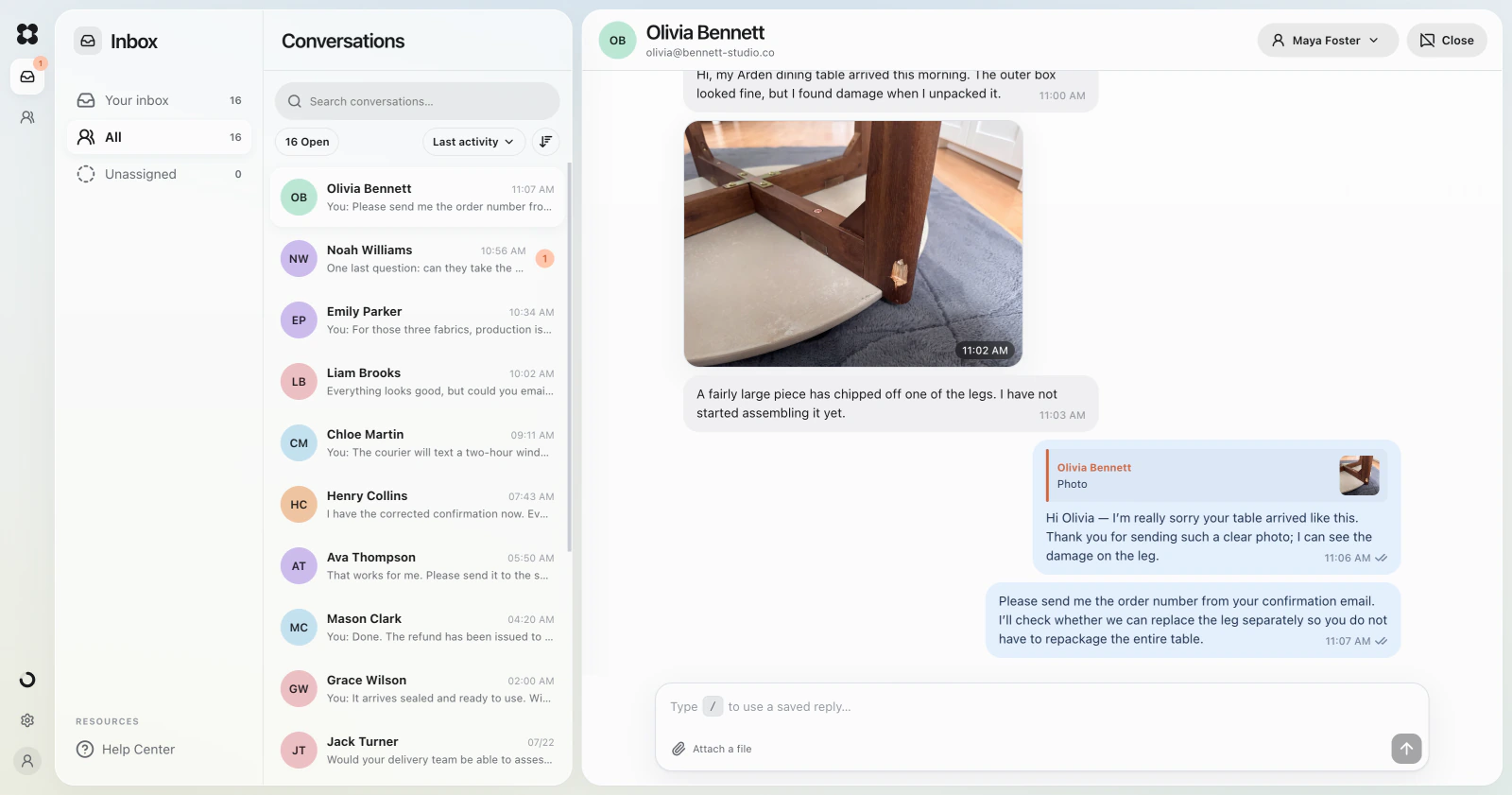
Lavenity is built around live and messaging-first support. Website chat, an inbound support email address, Telegram and Instagram Direct all land in one queue, Ven answers routine questions from your knowledge base within the volume your plan includes, and teammates get grounded drafts without a separate AI licence.
See what Help Scout really costs
Drag the sliders to size it for your team.
Lavenity Growth
$71/mo
$71 base · 10 teammates · AI included
Help Scout
$755/mo
10 seats × $38 · 500 × $0.75 per resolution
Priced on the Help Scout Plus plan at annual billing.
You save$684/mo · 91% less with Lavenity
Help Scout is priced here on Plus at about $38 per user per month on annual billing, with AI Answers billed at $0.75 per resolution. Both columns use published list prices in US dollars at annual billing, reviewed on August 2, 2026. Lavenity is also sold in EUR and UAH.
Three reasons teams move from Help Scout
Customers write from more places
Website chat, Telegram and Instagram Direct arrive in the same queue as email, with source, history and ownership intact.
AI volume is part of the plan
Growth includes 1,000 autonomous AI replies and Scale 2,500, then $0.085 per reply — instead of a per-resolution charge with no included allowance.
Team growth is an add-on, not a tier
Extra teammates cost $10 per month each up to the plan ceiling, and Scale has no seat limit at all.
Lavenity vs Help Scout, line by line
Where the products overlap, where the price diverges, and what Help Scout still does better.
| What you are comparing | Lavenity | Help Scout |
|---|---|---|
| Pricing model | Per workspace, from $27/mo | Per user, about $21–$63/user/mo |
| Teammates | 3 on Starter, 10 on Growth, unlimited on Scale | Every user is a paid seat |
| AI agent pricing | 1,000–2,500 replies included, then $0.085 each | AI Answers at about $0.75 per resolution |
| AI help for teammates | AI Assist and AI Compose included from Growth | AI drafts and summaries included |
| Messaging channels | Telegram and Instagram Direct included | Email-first, limited messaging channels |
| Live chat | Website chat widget on every plan | Beacon chat and self-service |
| Reporting | Response, resolution, AI performance and handoff reports | Solid mailbox and productivity reporting |
| Public help center | On the roadmap, marked coming soon | Docs knowledge base included |
Moving off Help Scout
Forward the mailbox, bring the docs, add the channels you were missing.
Point the mailbox here
Route your support email address into Lavenity so the queue your team watches is the queue customers write to.
Bring your Docs content
The articles behind Beacon become knowledge-base sources for Ven, so autonomous answers cite what you already published.
Turn on the live channels
Add the website widget, Telegram and Instagram Direct — the part of support that email-first tools leave uncovered.
Switching from Help Scout
What is the best Help Scout alternative in 2026?
If your support is mostly email and stays that way, Help Scout is hard to beat on craft. If customers increasingly reach you through website chat, Telegram or Instagram Direct, Lavenity handles those channels in the same queue and includes an autonomous AI agent in the workspace price.
Is Lavenity cheaper than Help Scout?
It depends on team size and AI volume. Help Scout Plus is about $38 per user per month on annual billing, so ten users is roughly $380 before AI Answers at $0.75 per resolution. Lavenity Growth is $71 per month at annual billing for ten teammates with 1,000 AI replies included. The calculator above compares your own numbers.
How much does Help Scout cost in 2026?
Help Scout publishes per-user plans of roughly $25, $45 and $75 per user per month billed monthly, with annual billing around 16% lower — roughly $21, $38 and $63. The AI Answers chatbot is billed separately at about $0.75 per resolution, while AI drafts and summaries for agents are included.
Does Lavenity have an AI agent like AI Answers?
Yes. Ven AI Agent replies to customers autonomously using your knowledge base, works in multiple languages, follows a tone and answer length you configure, and hands off to a teammate with full context. You can preview and test answers before it replies to anyone.
Can Lavenity replace Help Scout?
For teams whose support runs across chat and messaging as well as email, yes. The one thing to plan for is self-service content: Help Scout ships Docs today, while Lavenity's public help center is on the roadmap and marked coming soon. Knowledge-base content still powers Ven's answers in the meantime.
What does Help Scout do that Lavenity does not?
Help Scout has a mature public Docs knowledge base and a long-refined email workflow. Lavenity's public help center, custom inbox views, snoozing and CSAT ratings are on the roadmap and shown as coming soon rather than as shipping features.
How long does it take to migrate from Help Scout?
Usually a day. Forwarding the support address takes minutes, the widget is one script tag, and the Docs articles you already maintain can be reused as knowledge-base sources. The 14-day trial needs no card, so you can run both in parallel.
Does Lavenity charge per teammate?
No. Plans are priced per workspace with teammates included — three on Starter, ten on Growth and unlimited on Scale. Extra teammates on Starter and Growth are a $10 per month add-on up to the plan's ceiling.
Give messaging-first customers more than an email queue
Bring website chat, Telegram, Instagram Direct and grounded AI into the same workspace as your team.